Overview
Simple Agent is a deliberately small, living framework for experimenting with LLM agents. Its central loop is explicit: collect perception, infer the next step, perform an action, and continue until the system has no new stimuli or incomplete tasks.
The design problem
An agent is more than a model response. It needs current context, durable memory, a goal representation, bounded capabilities, a way to report activity, and a stopping condition. Simple Agent isolates those concerns so they can be changed and tested independently.
System design
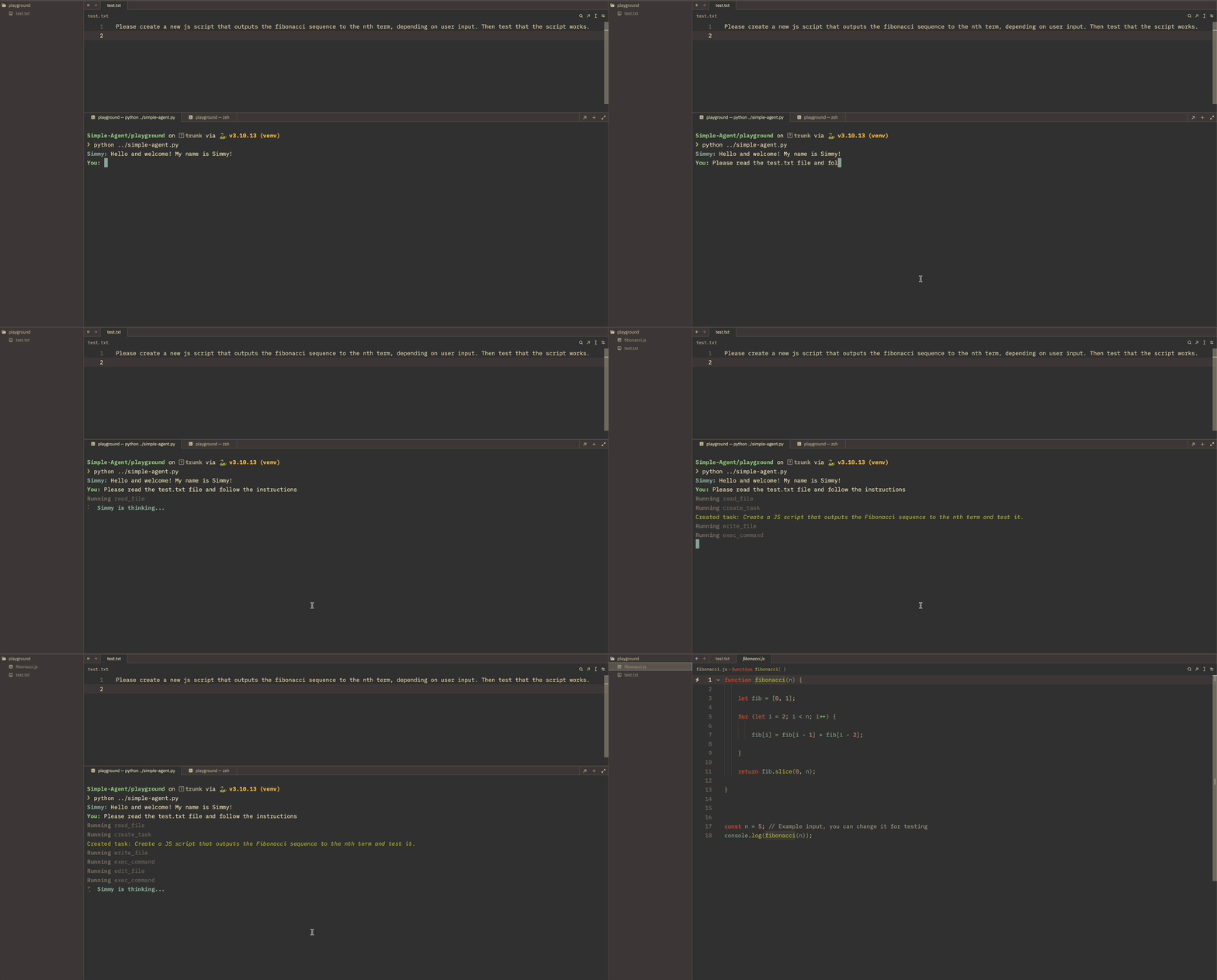
The Agent class gathers messages and tool outputs, recalls relevant memory and incomplete tasks, builds a prompt from environment, memory, and agency, then routes model responses or tool calls through a central Toolbox. Tasks carry descriptions, requirements, notes, and completion state rather than existing only as implicit prompt instructions.
Provider adapters cover OpenAI, Anthropic, and Google. Roles such as Helpful Assistant, Developer, and Researcher compose different tool sets. Optional semantic and episodic memory is stored as Markdown through a vector-store interface, with Simple Vector Store supplying a local retrieval backend. Rich, dotenv configuration, and event logging keep the command-line experience inspectable.
What the work demonstrates
The project shows hands-on understanding of agent control flow, tool contracts, provider abstraction, role-specific capability sets, and retrieval-backed memory. Its public development record runs from August 2024 through April 2025, with periodic updates continuing after the initial feature burst.
Engineering boundary
The framework intentionally exposes powerful tools, including file operations and shell execution. The reviewed snapshot does not show a sandbox, approval gate, path policy, or isolation layer. That limitation is part of the project’s value as an engineering study: capability needs consent, scoped permissions, review, rollback, and recovery before it can be treated as safe autonomy.