My favorite song is Comfortably Numb by Pink Floyd. I’m no music expert, so it’s difficult for me to articulate exactly why. But what I do know is that my favorite rendition of the song is from the band’s 1994 concert in London, from their Division Bell Tour. The setting of the concert itself is enormous, invoking feelings of awe through the visual aspects alone. However, the absolute best part of this performance, is David Gilmour’s iconic second solo.
If you haven’t heard it already, I’d highly suggest giving it a listen. David Gilmour is what every soloist aspires to be, making use of every note, and sending chills down the spines of his audience. The band gets credit too, of course, for providing the canvas for Gilmour’s brush. The solo ebbs and flows, building to an enormous finish, and an explosion of applause.
Pretty much what you’d expect from a giant rock concert. These artists are the best of the best, after all. They play the greatest music. Or does the music play them? Here’s a philosophical question you can use to sound pretentious at your next dinner party: does the musician play the music, or does the music play the musician? It’s a good question.
If your guests choose to indulge, there will likely be arguments from various stances. For one, surely the musician plays the music, through their specific actions, they create sounds which harmonize and build on one another, culminating in what we may call a song. On the other hand, every decision made by the artist is done relative to the decisions made before, therefore as the music goes on, it influences how the musician plays.
It seems that the goal of this line of questioning is to make a point. The musician plays the music, and the music plays the musician. They feed off of each other, and give rise to the eventual creation. It’s a dance.
Generations
In August 2022, an AI-generated art piece won the “digital arts/digitally-manipulated photography” category of the Colorado State Fair Fine Arts Competition. This made people mad. The art piece, created using Midjourney’s transformer-based image generation tool, sparked obvious controversy amid the artistic community. Concerns were raised whether this award-winning image could be considered “art” at all.
Of course, many thought the answer was no. A machine made the final product, and this process shouldn’t be allowed in art competitions for the same reason that robots can’t compete in the Olympics. Using an image generator is like removing the work and skill that makes the art impressive and interesting. Why should someone be bothered to view and interpret that which no one bothered to truly create.
On the other hand, the creator, Jason M. Allen, argued that this characterization wasn’t fair. His piece required 80 total hours of effort, after fine-tuning the prompt, getting final images, increasing the resolution, and correcting mistakes in photoshop. The art invoked feelings in people, who enjoyed viewing the image, and thought it was beautiful. No one originally suspected that the piece was AI-generated, although Jason was upfront about Midjourney being used.
So, is a generated image “art”? Well, that depends. Art is an elusive term, which has evaded strict definition by philosophy, due to its inherently flexible nature. Art likes pushing boundaries, breaking the rules, being loose and free, and so we don’t have a definition of what “art” is. This is a strange predicament for the world, as this looseness of art gives us such revolutionaries as Leonardo da Vinci, Claude Monet, and Vincent van Gogh, but also bananas taped to walls.
This fluidity makes things difficult to nail down. Generative images likely won’t simply be “banned”, as it’s difficult to draw a non-arbitrary line between two creations. Is any AI model used in the creation of a digital art piece banned? What about line-detection programs, which allow for easier editing in photoshop but use machine learning? How about noise removal, resolution enhancements, or colorization?
Personally, I think that people give these models a bit too much credit. They’re not people, they’re tools, which can convert text to an image. One key metric may be the ratio of decisions made by the machine versus the artist. However, this would define art as the result of a procession of decisions, made by the creators, which might be a bit too strict for that community.
In the meantime, the competition has opted to require AI-generated entries to be prominently disclaimed. Given the disdain by the artistic community around generative art, this will likely quell future attempts in art competitions using the medium. However, this approach does allow a more organic process to unfold.
Art and the Unconscious
In pursuit of defining the undefinable, instead of asking “what is art”, perhaps we can ask “where does art come from”? Carl Jung, notably, believed that artistic expression was a window into the workings of the unconscious mind. The unconscious, for that matter, is a wild and vast place. A realm occupied by archetypal entities, collective symbols, and instinctual processes.
In Jungian psychology, the unconscious mind communicates through the language of symbols. Dreams, for example, don’t make sense explicitly, however can be understood as the unconscious mind attempting to communicate with the conscious. A recurring dream might have meaning, which, if interpreted carefully, can reveal unconscious content to the conscious mind.
To tie it back, art can be understood as an expression of the unconscious mind, through the medium of the artist. The artist, in this case, has shaped their skills to be able to translate these unconscious contents into physical form. A painter understands how to capture the nuances of an image with the paintbrush, and a digital artist can do it using their respective tools and canvas.
While again, we can’t easily claim whether something is “art” or not, perhaps we can use this interpretation as a reference point. If art is an expression of the unconscious mind, then would a generative image count? I think the answer would be sometimes yes, mostly no. Perhaps some skilled artists could integrate generative art into something which is truly expressive, but most of the time this won’t be the case.
A painter crafts their art through a series of applications of paint to a canvas. Each stroke of the brush is an individual decision. Therefore, a painting is a composition of tiny nuances, each decision made by the artist as a result of unconscious and conscious processes. A generated image may have some root in a human decision through the prompt. However, the result of the process is much more a representation of the weights and biases of the model than the human mind itself.
Do people care?
None of these musings on the meaning of art actually matter, if artists can’t get paid for their work. Philosophers and creatives can tell people all they want about how generative AI can’t actually make art all by itself. However, if an end-user can get what they want at a significantly lower cost, then why wouldn’t they? What does job security look like for the creatives among us? Where is the moat?
According to research by Goldman Sachs, generative AI has the potential to automate roughly 26% of tasks performed by artists. Well isn’t that a scary number? Some reports indicate that artists are already losing out on career opportunities, especially in concept art circles and entry-level positions. It would seem that key cost centers to businesses may be automatable using generative models, and therefore the efficiency game comes to play.
However, a question remains about the sustainability of this endeavor. Perhaps certain tasks done by artists can be automated, however is this automation a true replacement of quality? Also, while automation of certain tasks might be practical, does this really mean that the artists themselves have been automated?
Working as a software developer, I write code, manage servers, deploy applications, fix bugs, collaborate with team members, etc. I perform many tasks throughout the day. If I could automate 26% of those tasks using generative AI, I would actually consider that an absolute win, and I think my employer would too. That’s because while it may initially sound scary that 26% of my job could be automated, my job isn’t to perform tasks.
While many specific operations do certainly fall under my purview, my job is to build and own software. Responsibility for the well-being of the application falls on me. Quality control falls on me. My job is to make it so that those who hired me don’t have to worry about individual tasks, or which operations need to be performed. Likewise, artists are not simply tasked to perform specific operations.
Obviously, at times they certainly are, and being skilled in a specific area is certainly a selling point. However, when I hire an artist, I am doing so to achieve a goal. For example, the thumbnails you see on these posts are all done by a professional, who I trust to maintain the look and feel of the publication. I have delegated this specific area of value to another person, who can better ensure quality. Notably, I don’t care what tools he uses. If he decides to use generative AI, that’s within his purview, as long as quality is maintained.
While generative AI might be capable of following instructions well, would you delegate it the responsibility of a value center of your business? If a language model can replace the responsibility of an artist, then that artist could be replaced. However, even if a model could perform 99% of the tasks performed by an artist, I would still choose the person who I believe I could trust with the responsibility of that value center.
I’m not everyone, and I believe that many companies have been caught up in the sweet words of the AI hype-lords. They might genuinely believe that a generative model could cut their costs, and in pursuit of profit, cut jobs. However, I think that while we may see this happen, we’ll see three additional corresponding trends.
First, significant quality gaps in new areas which begin to rely on generative AI, will emerge. This could take the form of companies attempting to use generative models to replace artists, and seeing declines in final product quality. It could also take the form of newer, less skilled artists being hired as a cheaper alternative, given the promise of a productivity boost with new technology.
Second, we’ll see a consistently growing backlash against uncanny generative images. Platforms like Cara are already popping up and growing in popularity while marketing themselves as human-only. People will grow increasingly wary of generative AI, and take steps to filter it out of their lives, where possible. Automated AI detection will continue to be a significant market, and people will strive for real human connection.
Third, and perhaps most excitingly, the artistic community will adapt to new technologies. While I might not call it “art” when I play around with Dalle 3, real artists will likely be able to use it in the creation of awesome things. Jason M. Allen, the now infamous contest winner, has already begun exploring this path. Other artists like Kris Kashtanova are covering and integrating innovations into their projects.
These trends will act as a corrective force, and I think we’ll see an evolution in the creation of beautiful things.
Take it away
To conclude my ramblings, I think we can safely say that this is a complex issue. There are a lot of variables at play here. However, I feel it’s safe to say that most AI-generated images online are not “art”, and those which could be considered art will require an artist to bring them into the world.
The level of complexity and nuance between the inspiration for a piece of art, and the existing work, will remain to some degree a measure of its worth. Artists will not be replaced, because fancy mathematical expressions will not actually capture anything of substance.
Specific tasks may be automated, but the responsibility of creativity, design, and artistic expression will still need to fall on the artists themselves. The future will be interesting, but at least a part of it will be bright. Perhaps Dosteovsky said it best, that “beauty will save the world.”
Author’s Note
This is a really interesting conversation to me, especially since it has so much overlap with concerns over job security of my own position. Software developers wonder if they’ll be automated by the next OpenAI release or some other Silicon Valley startup. I personally think that we’re safe for a while. I’ve noticed some productivity boost in my work using tools like language models, but I don’t think my employers are going to replace me with ChatGPT anytime soon.
I’m very interested in your thoughts on the topic, however. I’m not an artist, so if you have insights I’d love to hear them. You can send me a message directly, leave a reply below, or find me over on Substack Notes. As always, thank you reading, and I’ll see you next time. Goodbye.
Credits
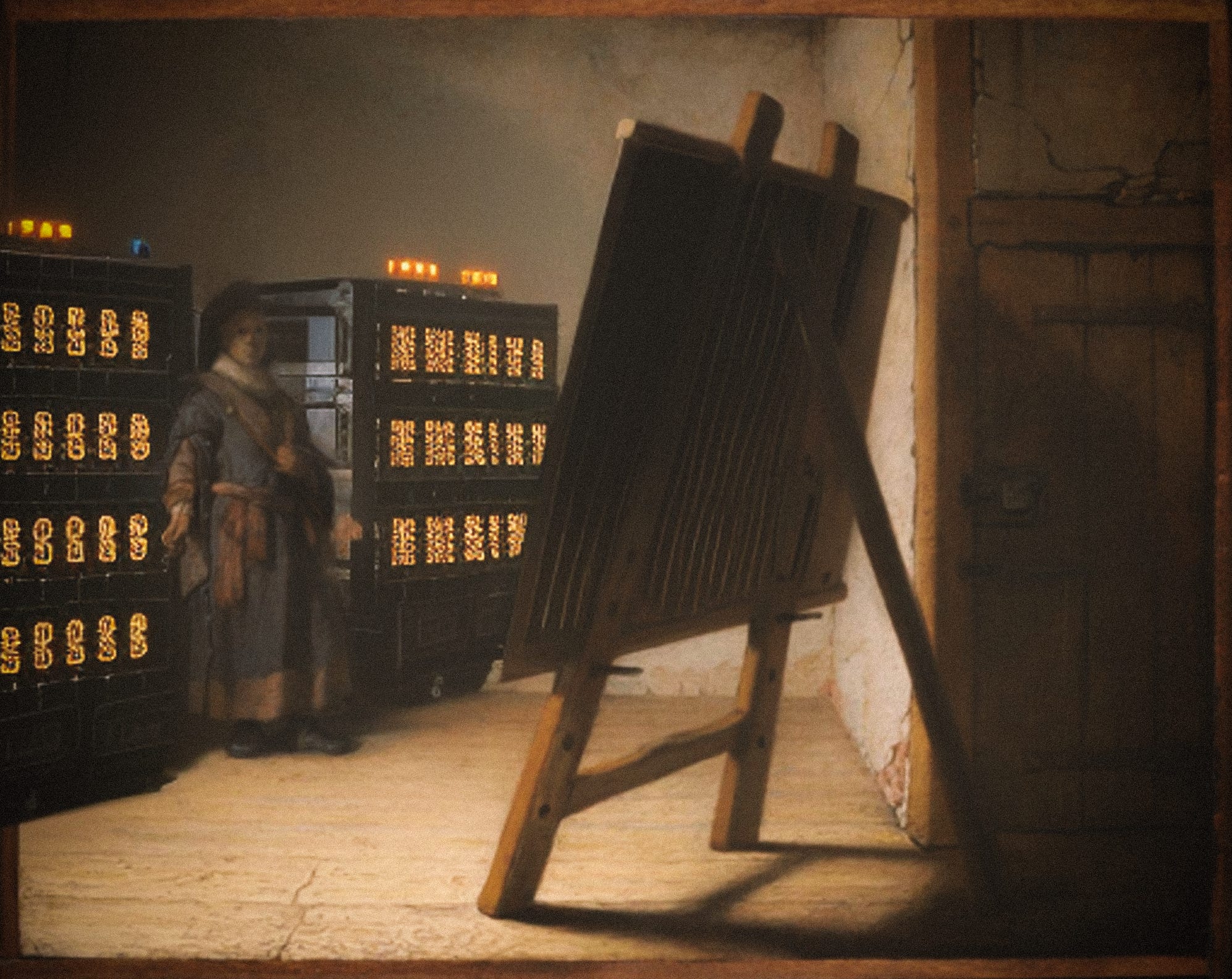
Thumbnail: Bilal Azhar at https://substack.com/@intelligenceimaginarium
Background Music:
Track - Marshmallow by Lukrembo, Source - https://freetouse.com/music, Free Music No Copyright (Safe)